
Sh Uthaymeen explains the hadeeth of `adwa (contagion) (Part 3) – comments

In light of the previous two articles quoting from Sh Uthaymeen rahimahullaah, the following points should be clear:

  • The hadeeth “there is no ‘adwa (contagion)” doesn’t deny the existence or effect of contagious or infectious disease. Rather it refutes the concept that these diseases act separately from the permission and decree of Allaah.
  • Other hadith indicate that infectious disease is real. The Prophet sallAllaahu’alaihiwasallam clearly affirmed this and in fact advised people to take precautions from the spread of such disease (by fleeing from the leper and by keeping sick camels separate from healthy camels).
  • Such precautions are in keeping with what the modern medical profession advises with – by cleaning, disinfecting, isolating and quarantining the sick, using forms of protection such as face masks and gowns where needed etc. One can see that there is agreement between the Sunnah, the modern-day scholars (such as Sh Uthaymeen and Sh Fawzaan etc.) and the medical profession in these matters. In fact the scholars refer to the doctors in these issues and advise people with this.
  • This balanced approach has actually been implemented during the ongoing COVID-19 epidemic in Saudi Arabia where we have seen co-ordination and co-operation between the government, the scholars and the medical profession who have worked together to implement precautions against coronavirus. Although there have been many ill patients – filling up the wards and intensive care units in my own hospital in Jeddah for example, and in many other hospitals around the country, the epidemic has been controlled without hospitals being overwhelmed. This has led to a relatively low death rate when compared to other countries – walillaahilhamd.
  • Please beware of bizarre statements about these issues – like for example claims that infectious diseases don’t exist or that taking precautions such as wearing face masks is a type of ‘minor shirk’. No appropriately qualified doctors or scholars say such things. Also please be very cautious when scholars from centuries ago are quoted out of context.
  • Spreading medical misinformation is a serious matter. It may lead to innocent and medically vulnerable people becoming ill and dying. Nasa’Allaahal’aafiyah wasSalaamah.

Dr Adnaan Ali
MBBChir (medical doctor)
Sh Uthaymeen explains the hadeeth of `adwa (contagion) (Part 2)

(In the excerpt below Sh Uthaymeen explains that contagion (i.e. infectious diseases) are real and that the Prophet sallAllaahu’alaihiwasallam affirmed this. He sallAllaahu’alaihiwasallam also said that one should take precautions against the spread of such diseases by isolating the sick from those who are healthy).


Sh Uthaymeen continued in his commentary:

With regard to the words “no contagion (‘adwa)”: contagion is something that happens, as is indicated by the words of the Prophet (peace and blessings of Allaah be upon him), “Do not put a sick one with a healthy one” i.e., the owner of a sick camel should not bring it to the owner of a healthy camel, lest the contagion be transmitted.

And the Prophet (peace and blessings of Allaah be upon him) said: “Flee from the leper as you would flee from a lion.” Leprosy is a serious disease that is transmitted quickly and kills the one who catches it. It was even said that it is a plague. Hence the command to flee from the leper so that the disease will not be transmitted from him to you. This is an affirmation of the effect of contagion, but its effect is not inevitable in such a way that it affects people by itself. The command of the Prophet (peace and blessings of Allaah be upon him) to flee and not to bring sick camels to where healthy camels are comes under the heading of avoiding the means (that lead to sickness), not attributing the effect to the means themselves. The means do not affect anything themselves, but we should avoid the things that may be a cause of calamity, because Allaah says (interpretation of the meaning):

“and do not throw yourselves into destruction”
[al-Baqarah 2:195]

We cannot say that the Messenger (peace and blessings of Allaah be upon him) was denying the effect of contagion, because contagion is something that is proven to exist in real life and is mentioned in other ahaadeeth.

When the Prophet (peace and blessings of Allaah be upon him) said “there is no ‘adwa”, a man said: “O Messenger of Allaah, the camels may be healthy like deer, then a mangy camel comes and mixes with them and they all get the mange.” The Prophet (peace and blessings of Allaah be upon him) said: “And who infected the first one?” meaning that the disease came to the first one with no contagion, rather it came from Allaah. By the same token, if it was transmitted by contagion, then it was transmitted by the command of Allaah. A thing may have a known cause or it may not have a known cause. The mange of the first one does not have a known cause, apart from the fact that it happened by the will and decree of Allaah, and the mange that came after it does have a known cause. But if Allaah wills the camel will not become mangy. Hence sometimes a camel may get the mange but then it recovers and does not die. The same happens with the plague and cholera; they may enter a house and some may get sick and die, while others are not affected at all.

[Sharh Kitaab al-Tawheed, 2/80]


(Note that “mange” refers to a type of skin disease which affects animals).

Sh Uthaymeen explains the hadeeth of `adwa (contagion) (Part 1)

(In the excerpt below Sh Uthaymeen explains that causes do not have an effect in and of themselves, but only do so by the permission and decree of Allah).

From Kitab-ut-Tawhid (Regarding the prohibition of believing in bad omens):

Abu Hurairah radiyAllaahu `anhu said that Allaah’s Messenger sallAllaahu’alaihiwasallam said:

There is no `adwa (contagion), nor tiyarah, nor haamah (types of bad omens related to birds), nor safar (reading bad omens into the month of Safar)

Reported by Bukhari and Muslim.


Sh Uthaymeen said in his commentary:

The words of the Prophet (peace and blessings of Allaah be upon him) “There is no ‘adwa” are general in meaning, thus the Prophet (peace and blessings of Allaah be upon him) states that there is no contagion (without the permission of Allaah).

‘Adwa (contagion) refers to the spread of a disease from a sick person to a healthy one. What happens in the case of physical diseases may also happen in the case of psychological diseases. Hence the Prophet (peace and blessings of Allaah be upon him) said that a bad companion is the like one who operates the bellows: Either he will burn your clothes, or you will notice a bad smell from him.

The words “there is no ‘adwa” include both physical and psychological diseases, even though it is more apparent with regard to physical disease.

The words “no tiyarah (lit. superstitious belief in bird omens)” refers to feeling superstitious because of something that you see, hear or know.

With regard to the words “no haamah”, haamah is interpreted in two ways:

1 – That it is a bird similar to an owl, or an owl. The Arabs believed that if a person was killed, his bones became a haamah that could fly and shriek until he was avenged. Some of them believed that the haamah was the soul of the slain person.

2 – Some of the Arabs said that the haamah was a particular bird, which they regarded as a bad omen. If it landed on the house of one of them and made a sound, they said that it was predicting a death. They believed that this was a sign that that person would die soon. All of these are undoubtedly false beliefs.

The words “No Safar” refers to the month of Safar, which the Arabs used to regard as inauspicious, especially for marriage.

And it was said that it was a stomach disease that affected camels and was transmitted from one camel to another; based on this, mentioning it after ‘adwa (contagion) comes under the heading of mentioning something specific after something general.

It is more likely that what is meant by Safar here is the month, and that what is meant by saying “No Safar” is that it is not to be regarded as inauspicious, rather it is like any other time, during which good or bad things may be decreed.

This does not mean that these things do not happen, because they do happen. Rather it is a statement that they do not have any effect. The One Who causes things to happen is Allaah. If any of these things has a known effect then that is valid and real; if any of them is imagined to have an effect, then that is invalid and false. Thus the hadeeth demonstrates that if there is a valid effect, it cannot be attributed to that thing itself (rather the One Who causes it to happen is Allaah). If the effect is merely imagined, then this hadeeth is stating that it has no effect in the first place.

Ten points to help protect oneself against Coronavirus (Sh AbdurRazzaaq al-Badr)

Ten Points to Help Protect Oneself Against Corona

The Ruling on Using Vaccinations as a Treatment before the Illness Occurs (Sh Bin Baz)

Q.  “ What is the ruling on taking medicines/treatment before the illness occurs, such as vaccinations (at-Tat`eem)? ”


A. “ There is no harm in taking medicines/treatment if he fears that an illness may occur, because of the presence of an epidemic (wabaa·); or because of other reasons, on account of which he fears that illness may occur. So there is no harm in taking a medicine to repel the ailment which he fears. This is because of the saying of the Prophet (sallallaahu `alaihi wa sallam) in the authentic hadeeth:

“Whoever takes seven dates of al-Madeenah in the early morning, then he will not be harmed by sorcery or poison.” 

This is a case of repelling an affliction prior to its occurrence. So likewise if he fears an illness and takes a vaccination against the illness which is occurring in the land, or in any place: there is no harm in tha,t as a case of prevention: just as an illness that has occurred can be treated with the medicine for that illness.                                                       

However it is not permissible to wear amulets and charms to ward off  illness, or the jinn, or the evil-eye, since the Prophet (sallallaahu `alaihi wa sallam) forbade that; and he -`alaihis-Salaatu was-Salaam- made clear that this is from lesser shirk, so it is obligatory to beware of that.”


[ Shaikh `Abdul-`Azeez ibn Baaz –rahimahullaah-: ‘Majmoo` Fataawaa wa Maqaalaat mutanawwi`ah’ (6/26-27).]


Translated by Abu Talhah rahimahullaah.

Use Ruqya AND Medical Treatments (Sh Fawzaan)


A questioner from another country says:


Q:

In our country there are some people who ascribe to the methodology of the Salaf who are trying to implement shar`ee ruqya.[1] They have set up a special center specifically for this ruqya. They take fees and they encourage people to avoid being treated with modern medicine. They say that these are the medicines of the disbelievers, and one should not use such treatments. What would you say about this?


A:

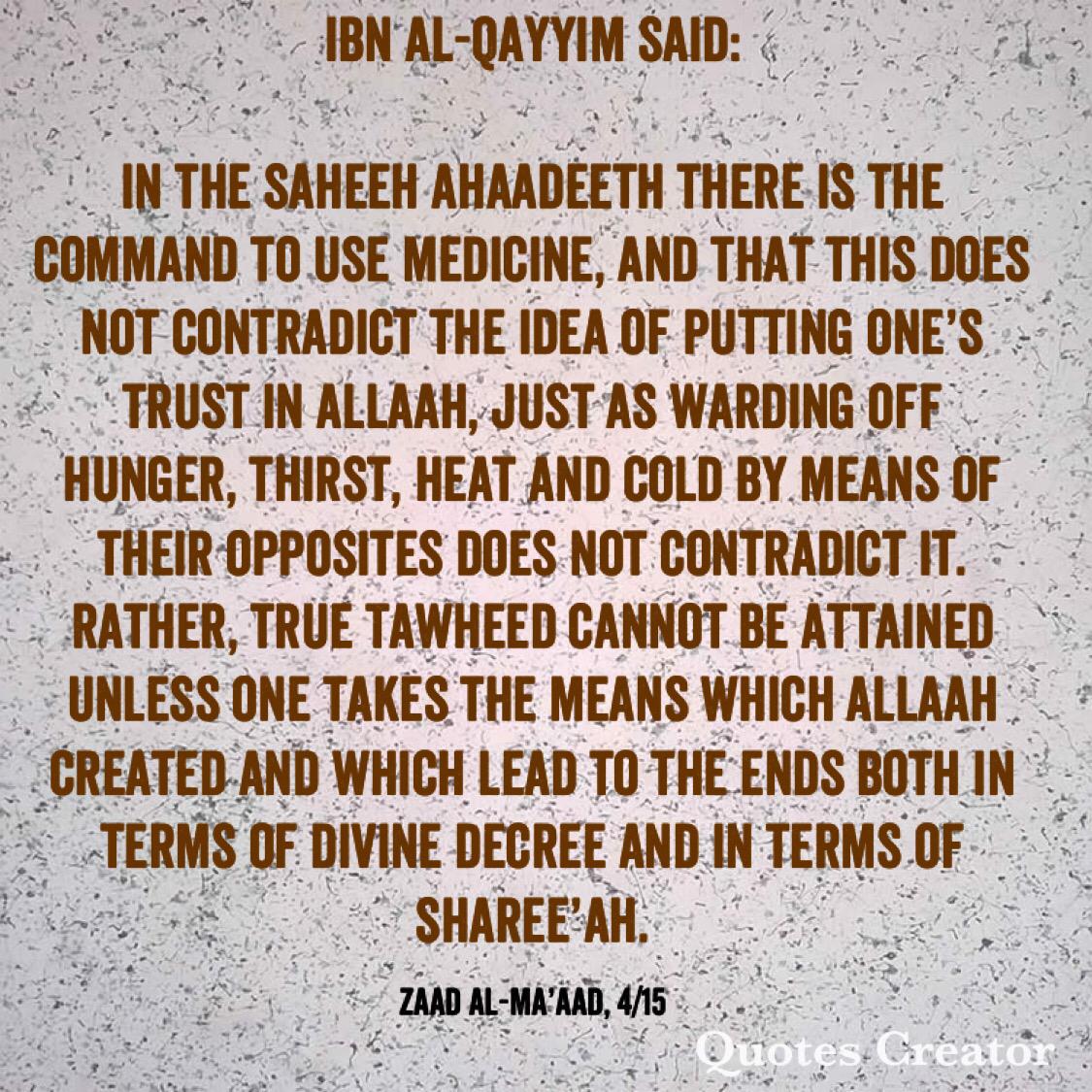
This is a baseless claim. Yes, one should seek treatment through the Qur’aan and ruqya, there is no problem with this. However, this does not stop one from seeking treatment through medicine also. “Allaah did not send down any disease without also sending its cure, whether one is aware of it or not.”[2]


___________________

[1] i.e. when the Qur’aan is recited over oneself or others in order to cure illness

[2] Saheeh – see as-Saheehah no.s 451 & 1650

Only the Prophetic Medicine?

Some people think that we should try and only use specific Prophetic and ‘natural’ medical treatments and avoid modern medicine as far as possible. Is this correct?

Evidence from the Sunnah, statements of the Companions and from the example of the Scholars.

Presented by Dr Adnaan ibn Salman:


Use Prophetic Medicine as well as Other Medical Treatments

Should modern medical treatment be avoided in favour of the Prophetic Medicine? (Sh Fawzaan)


Q:

There are some people who advise with using the Prophetic Medicine and they warn against some modern day medical treatments, and we have seen that some patients have come to harm as a result of this warning, so what would you advise concerning this?

A:

The Prophetic Medicine which is authentically established is true and it is beneficial, and it should not stop you from using permissible medical drugs. It does not stop you from this. You can take both. They are all from that which Allaah has made to be a healing, as he sallAllaahu’alaihiwasallam said:

“Allaah did not send down a disease except that he sent down a cure for it – whether you are aware of it or not.”[1]

And he sallAllaahu’alaihiwasallam said:

“Take medical treatments and do not seek treatment in that which is haraam (impermissible).”[2]

So that medical treatment which is established and beneficial, then there is no problem in using it, along with using the Prophetic Medicine. They are both beneficial.


[1] Saheeh – see as-Saheehah no.s 451 & 1650

[2] Saheeh-ul-Jaami’ 1762