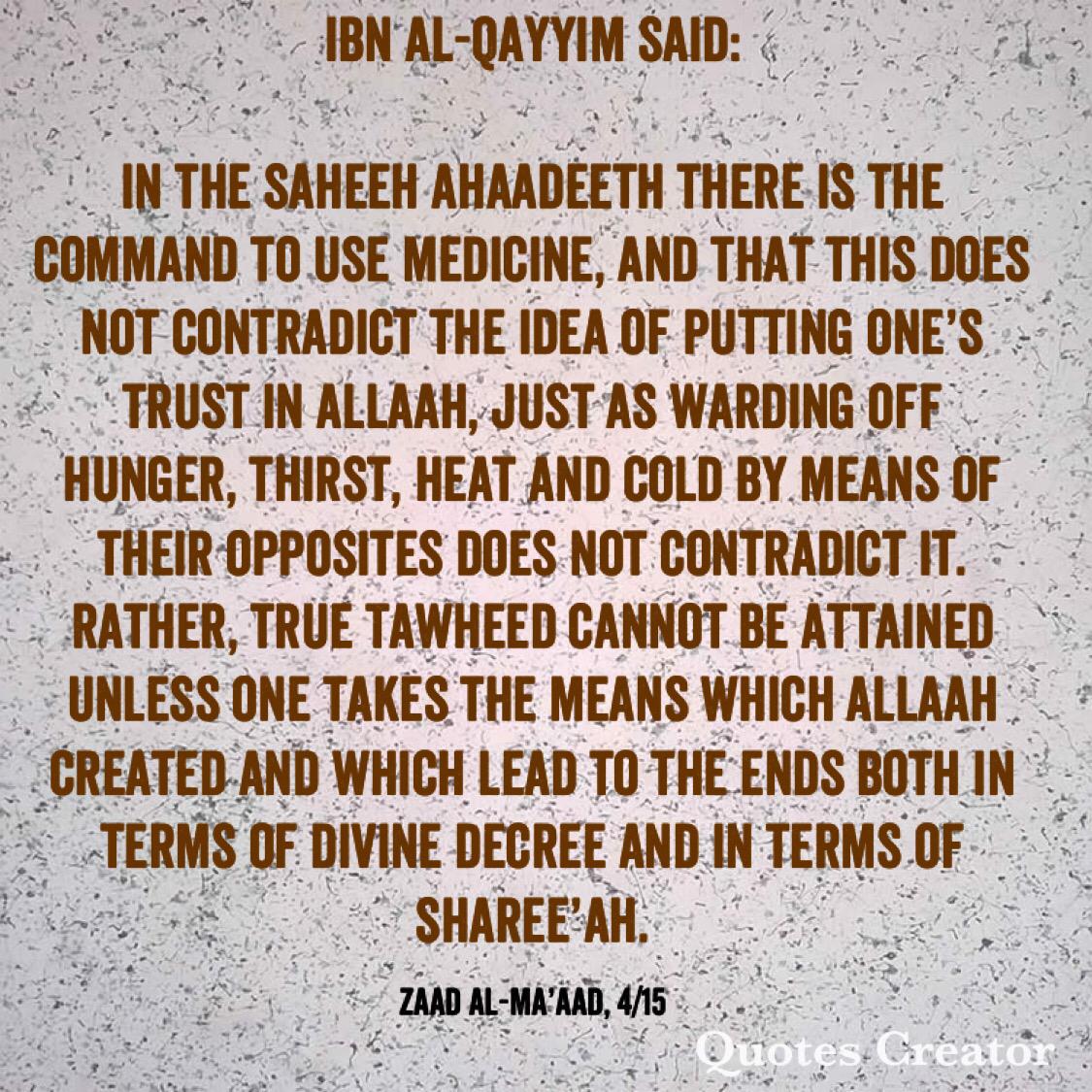
“Take medical treatment…”
Sh ‘AbdurRazzaaq al-Badr:
Based on the aayah:
وَإِذَا جَآءَهُمۡ أَمۡرٞ مِّنَ ٱلۡأَمۡنِ أَوِ ٱلۡخَوۡفِ أَذَاعُواْ بِهِۦۖ وَلَوۡ رَدُّوهُ إِلَى ٱلرَّسُولِ وَإِلَىٰٓ أُوْلِي ٱلۡأَمۡرِ مِنۡهُمۡ لَعَلِمَهُ ٱلَّذِينَ يَسۡتَنۢبِطُونَهُۥ مِنۡهُمۡۗ وَلَوۡلَا فَضۡلُ ٱللَّهِ عَلَيۡكُمۡ وَرَحۡمَتُهُۥ لَٱتَّبَعۡتُمُ ٱلشَّيۡطَٰنَ إِلَّا قَلِيلٗا
And when there comes to them information about [public] security or fear, they spread it around. But if they had referred it back to the Messenger or to those of authority among them, then the ones who [can] draw correct conclusions from it would have known about it. And if not for the favor of Allah upon you and His mercy, you would have followed Satan, except for a few.
(Surah An-Nisa’:83)
Q. “ What is the ruling on taking medicines/treatment before the illness occurs, such as vaccinations (at-Tat`eem)? ”
A. “ There is no harm in taking medicines/treatment if he fears that an illness may occur, because of the presence of an epidemic (wabaa·); or because of other reasons, on account of which he fears that illness may occur. So there is no harm in taking a medicine to repel the ailment which he fears. This is because of the saying of the Prophet (sallallaahu `alaihi wa sallam) in the authentic hadeeth:
“Whoever takes seven dates of al-Madeenah in the early morning, then he will not be harmed by sorcery or poison.”
This is a case of repelling an affliction prior to its occurrence. So likewise if he fears an illness and takes a vaccination against the illness which is occurring in the land, or in any place: there is no harm in tha,t as a case of prevention: just as an illness that has occurred can be treated with the medicine for that illness.
However it is not permissible to wear amulets and charms to ward off illness, or the jinn, or the evil-eye, since the Prophet (sallallaahu `alaihi wa sallam) forbade that; and he -`alaihis-Salaatu was-Salaam- made clear that this is from lesser shirk, so it is obligatory to beware of that.”
[ Shaikh `Abdul-`Azeez ibn Baaz –rahimahullaah-: ‘Majmoo` Fataawaa wa Maqaalaat mutanawwi`ah’ (6/26-27).]
Translated by Abu Talhah rahimahullaah.
A questioner from another country says:
Q:
In our country there are some people who ascribe to the methodology of the Salaf who are trying to implement shar`ee ruqya.[1] They have set up a special center specifically for this ruqya. They take fees and they encourage people to avoid being treated with modern medicine. They say that these are the medicines of the disbelievers, and one should not use such treatments. What would you say about this?
A:
This is a baseless claim. Yes, one should seek treatment through the Qur’aan and ruqya, there is no problem with this. However, this does not stop one from seeking treatment through medicine also. “Allaah did not send down any disease without also sending its cure, whether one is aware of it or not.”[2]
___________________
[1] i.e. when the Qur’aan is recited over oneself or others in order to cure illness
[2] Saheeh – see as-Saheehah no.s 451 & 1650
Questions from a Muslim Doctor in the West:
[1]:
There are some students of knowledge in the West who give medical advice on the internet. However, they are not doctors and have not trained in the fields which they give advice about. They tell people to treat themselves through changing their diet, while warning against well-established medical treatments such as vaccinations and medication for preventing heart attacks, using weak medical evidence to support their claims.
What would you advise these students?
Shaykh’s answer: Wa alaykumusSalaam wa rahmatullaahi wa barakaatuh, I advise these young men to return to the people of knowledge with regard to understanding the Book and the Sunnah. And the Prophetic medicine is a science of the Islamic legislation – it is not permissible for someone who is not proficient in it and who did not learn it at the hands of the scholars to speak about it. And censuring the medicine that is established by scientific tests is wrong, and the doctors used to practice a lot of it at the time of the Prophet (sallAllaahu ‘alayhi wa sallam) and he did not censure them; and it is included in the generality of the Prophet’s (sallAllaahu ‘alayhi wa sallam) statement: “Indeed Allaah has created both disease and remedy, so treat yourselves but don’t treat yourselves with that which is prohibited.” [as-Saheehah 1633 authenticated by Sh al-Albaani (slightly different wording from the hadith mentioned above)] And Allaah knows best.
[2]:
These students say that they wish to revive the Prophetic medicine. For example one of them says that “labanan khaalisan” [Soorat-un-Nahl:66] refers only to milk which has not been pasteurised. He says that drinking unpasteurised milk is an, “affirmation of tawheed”, and that drinking pasteurised milk is not in accordance with the sunnah, and is in fact harmful. He says that modern doctors prescribe medicines which prolong illness so that pharmaceutical companies can make more money. He says that the modern medical profession is based upon, “mu‘tazilee”, principles. He likens taking certain medications to the impatience of those who revolt against the rulers.
Is the approach of this student correct, as we have not heard the like of this from our ‘ulemaa?
Shaykh’s answer: The answer to this is like the answer to the previous (question), as it has branched off from it.
[3]:
We have advised these students, but they have not responded to our advice. Some of the common people have been influenced by these ideas, and they think that it is better to take only herbal and Prophetic Medicine and avoid modern medicines. They are reluctant to take precautions from the spread of diseases, claiming that illness only spreads by the permission of Allaah. We know of people who have become ill through following the advice of these students.
Should we as Muslim doctors publicly explain the errors of these students to the common people? Should we do so even if we are accused of causing splitting?
Shaykh’s answer: Yes, it is obligatory upon you to make their mistake clear to the people; and spread the speech of the scholars with regard to these issues and connect the people to the scholars, as these people are harming the people in the name of religion while they perceive not, and they think that they are doing good. There is no doubt that from modern medicine there is that which is beneficial and also that which is harmful, and there is no doubt about the existence of business companies whose concern is to gain profit. But that does not mean that everything made by the modern method of medicine is not beneficial; and in the like of this, it is obligatory to return to the trustworthy people among them who are duly qualified and have experience in order to know what is beneficial and what is harmful. And likewise, the Prophetic medicine is in need of one who understands it with a correct understanding so that it would be beneficial for the people because everyone who (just) read a book about that is not able to understand it. And there is no doubt that disease spreads by the permission of Allaah but the Prophet (sallAllaahu ‘alayhi wa sallam) said to us: flee from the leper like you flee from a lion, and he prohibited us from entering the place where there is plague and prohibited its people from leaving it, as a way of preventing the spread of the disease, and the discussion goes on. In general, it is obligatory to return to the scholars with regard to that. And Allaah knows best.
[Answered by Shaikh Ali ar-Ramlee hafizahullaah]
Download full PDF here:
Before answering the question I want to remind you of a principle accepted by those who are not Muslims too: that it is not permissible for someone who is ignorant of [a particular field of] knowledge to speak about it, because doing so goes against texts from the Book and the Sunnah, from them is the saying of our Lord, the Blessed and Most High:
وَلَا تَقْفُ مَا لَيْسَ لَكَ بِهِ عِلْمٌ ۚ إِنَّ السَّمْعَ وَالْبَصَرَ وَالْفُؤَادَ كُلُّ أُولَٰئِكَ كَانَ عَنْهُ مَسْئُولًا
“And do not pursue that of which you have no knowledge. Indeed, the hearing, the sight and the heart–about all those [one] will be questioned.” [Israa 17:36].
So for example it is not permissible for the one who wants to speak about medicine to do so if he is a scholar of Quranic exegesis [mufassir], since medicine is not his field. Just as it is not permissible for a doctor who is a specialist in his field to speak about Quranic exegesis or Islamic jurisprudence or other than that, because if both of these people talk about fields which are not their expertise then they have pursued that of which they have no knowledge, and would thus have opposed the previously quoted Quranic text.
I think this is a matter concerning which it is correct to quote the old Arabic parable: this is something about which no two will differ and over which no two rams will clash horns, i.e., it is not permissible for anyone to speak about a certain [field of] knowledge except for the specialists in it.
…
After this I come back to saying that it is not permissible for any person to speak about that which is not his specialism–particularly when it is clear that his speech in the field about which he has spoken without knowledge opposes that of those who are specialists in it.
https://thealbaanisite.com/2011/06/20/musa-and-the-angel-of-death-1/
The Relationship Between Medical Quackery and Shirk (Polytheism)
Some people think that we should try and only use specific Prophetic and ‘natural’ medical treatments and avoid modern medicine as far as possible. Is this correct?
Evidence from the Sunnah, statements of the Companions and from the example of the Scholars.
Presented by Dr Adnaan ibn Salman:
Q:
There are some people who advise with using the Prophetic Medicine and they warn against some modern day medical treatments, and we have seen that some patients have come to harm as a result of this warning, so what would you advise concerning this?
A:
The Prophetic Medicine which is authentically established is true and it is beneficial, and it should not stop you from using permissible medical drugs. It does not stop you from this. You can take both. They are all from that which Allaah has made to be a healing, as he sallAllaahu’alaihiwasallam said:
“Allaah did not send down a disease except that he sent down a cure for it – whether you are aware of it or not.”[1]
And he sallAllaahu’alaihiwasallam said:
“Take medical treatments and do not seek treatment in that which is haraam (impermissible).”[2]
So that medical treatment which is established and beneficial, then there is no problem in using it, along with using the Prophetic Medicine. They are both beneficial.
[1] Saheeh – see as-Saheehah no.s 451 & 1650
[2] Saheeh-ul-Jaami’ 1762
 Tibb.co